June 10, 2026
Why the Strongest Partnerships Begin Before the Proposal

Earlier last month, I attended two industry events on two different continents. The International Air Transport Association (IATA) Aviation Energy Forum in Paris. And the African Airlines Association (AFRAA) Stakeholders Convention in Johannesburg.
Different audiences. Different discussions.
Yet one message kept surfacing:
The organisations shaping the future of aviation and energy are increasingly the ones that can demonstrate stability, capability, and leadership when uncertainty appears.
The recent disruptions around the Strait of Hormuz have reminded global markets of a reality many leaders already understand:
Energy security is no longer an operational issue. It is a strategic issue. When supply chains become fragile, markets begin asking different questions.
Not who is cheapest or who is largest.
But who can be relied upon when pressure arrives.
Europe continues to face supply vulnerabilities. Fuel logistics remain exposed to geopolitical disruption. And as uncertainty increases, attention is shifting toward regions capable of strengthening resilience.
What was particularly interesting during conversations at both conferences was how often Africa appeared at the centre of the discussion.
Not as a future opportunity but as a current solution.
Most headlines focus on oil prices, some focus on renewable energy. But a quieter shift is taking place beneath the surface.
Refining capacity is becoming one of the most strategic assets in the world. When I saw the latest global refinery rankings, one detail stood out immediately.
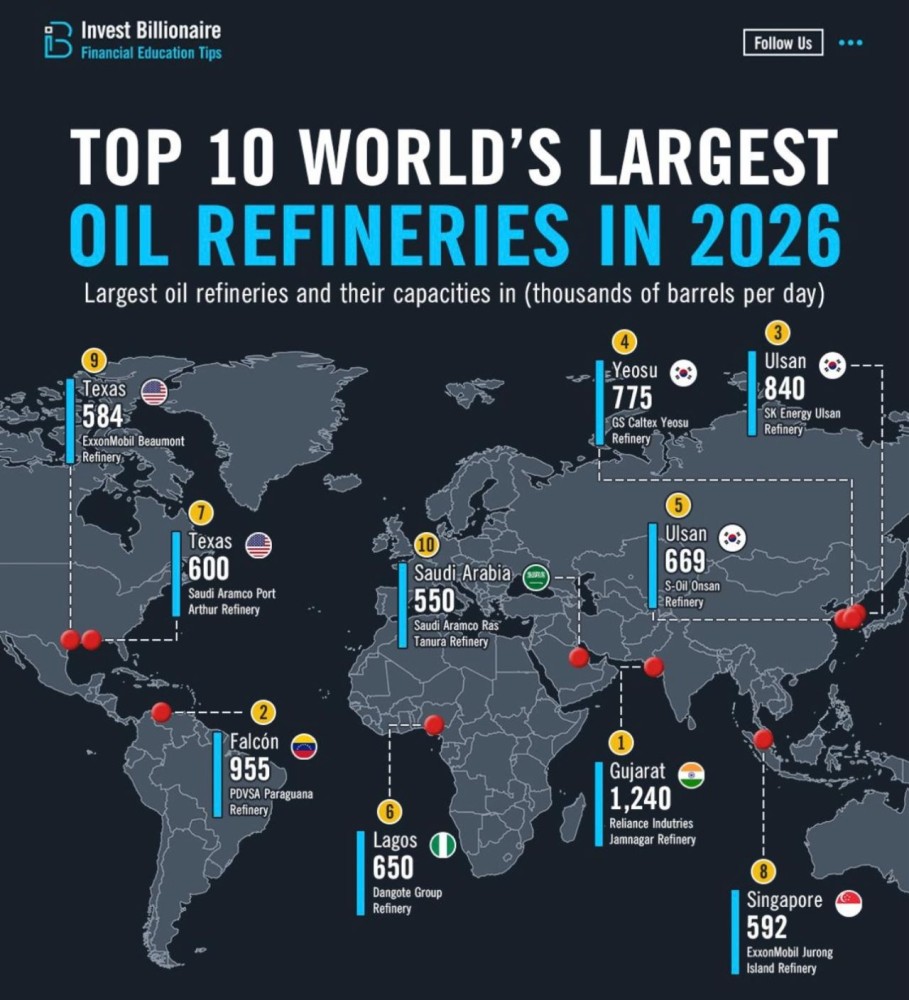
Africa now has a seat at the table. Not as a future participant — as a current player.
Global refining capacity is increasingly concentrated among a small number of strategic players. The emergence of the Dangote Refinery signals a new chapter for Africa's role in global energy security.
A Shift in Global Influence
For decades, discussions around refining leadership centred around the United States, South Korea, India, Saudi Arabia, and Singapore.
Today, Nigeria has entered that conversation. The Dangote Refinery now ranks among the largest refineries globally, with approximately 650,000 barrels per day of capacity.
That number alone is significant. But the bigger story isn't capacity.
It's influence, because refining capacity does more than process crude. It shapes trade routes, it strengthens supply resilience and it reduces dependency.
And increasingly, it determines who becomes strategically important during periods of disruption.
When Europe experiences pressure on fuel supply chains.
When geopolitical tensions create volatility.
When aviation markets face uncertainty.
Markets begin looking for stable alternatives. That changes the conversation from production to trust.
The Same Principle Applies to Leadership
This is where I see a direct parallel between energy markets and executive leadership. During my recent LinkedIn Live, Reputation to Revenue, I shared a simple observation:
High-value deals are rarely lost on price alone.
In many cases, they are won or lost long before procurement begins.
Why?
Because decision-makers are looking for certainty. Just as markets seek dependable supply partners, buyers seek dependable leadership.
Capability is assumed. Trust becomes the differentiator.
The leaders winning larger partnerships today are often not the most visible because they market more. They're visible because they've become recognised as credible.
Their reputation reduces perceived risk and risk reduction accelerates commercial decisions.
Commercial momentum is often created long before the meeting. Visibility keeps you in the conversation when opportunities emerge.
From Refining Capacity to Market Authority
One of the ideas I discussed during the live was that reputation should no longer be viewed as a branding exercise. It is a commercial asset.
Just as refining infrastructure creates resilience within energy markets, authority creates resilience within commercial growth.
When markets become uncertain:
Trusted refineries attract demand.
Trusted leaders attract opportunity.
Trusted organisations attract investment.
The pattern is remarkably similar. And in both cases, visibility matters. Because invisible capability creates uncertainty.
Visible capability creates confidence.
What This Means for Africa
What excites me isn't just the expansion of refining capacity — it's the deeper shift it represents. Africa is steadily moving from being a participant in global industries to becoming a strategic contributor, with clear evidence in aviation, energy, and infrastructure.
The real opportunity now lies in ensuring that markets recognise this leadership, because influence follows visibility, and visibility builds momentum over time.
That Raises a Critical Question for You
If someone researched your organisation today, would they see capability or leadership? The distinction matters, and increasingly, it's leadership that determines who gets chosen.
For CEOs and senior leaders operating in Energy, Aviation, Engineering, and Financial Services, I help organisations strengthen market authority through executive positioning, reputation strategy, and AI-powered commercial growth systems.
If you'd like a private assessment of your current authority positioning and digital market presence, send me a direct message.
Sometimes growth doesn't require more visibility.
It requires the right visibility.
Want more executive briefings like this?
Subscribe on LinkedIn